The project
Research applying computational methods to nanoparticle characterization. The spectral-analysis work uses dimensionality reduction and reconstruction to examine how precursor signals change, alongside a broader microscopy and detection workflow.
My contribution
I learned Python to set up, run, and test a YOLOv8 workflow for identifying nanoparticle clusters in TEM images. I then wrote code to select background-color pixels for detection calibration. For the spectroscopy work, I studied the mathematical principles of PCA, implemented them in Python, and presented the results in a research poster.
From question to method
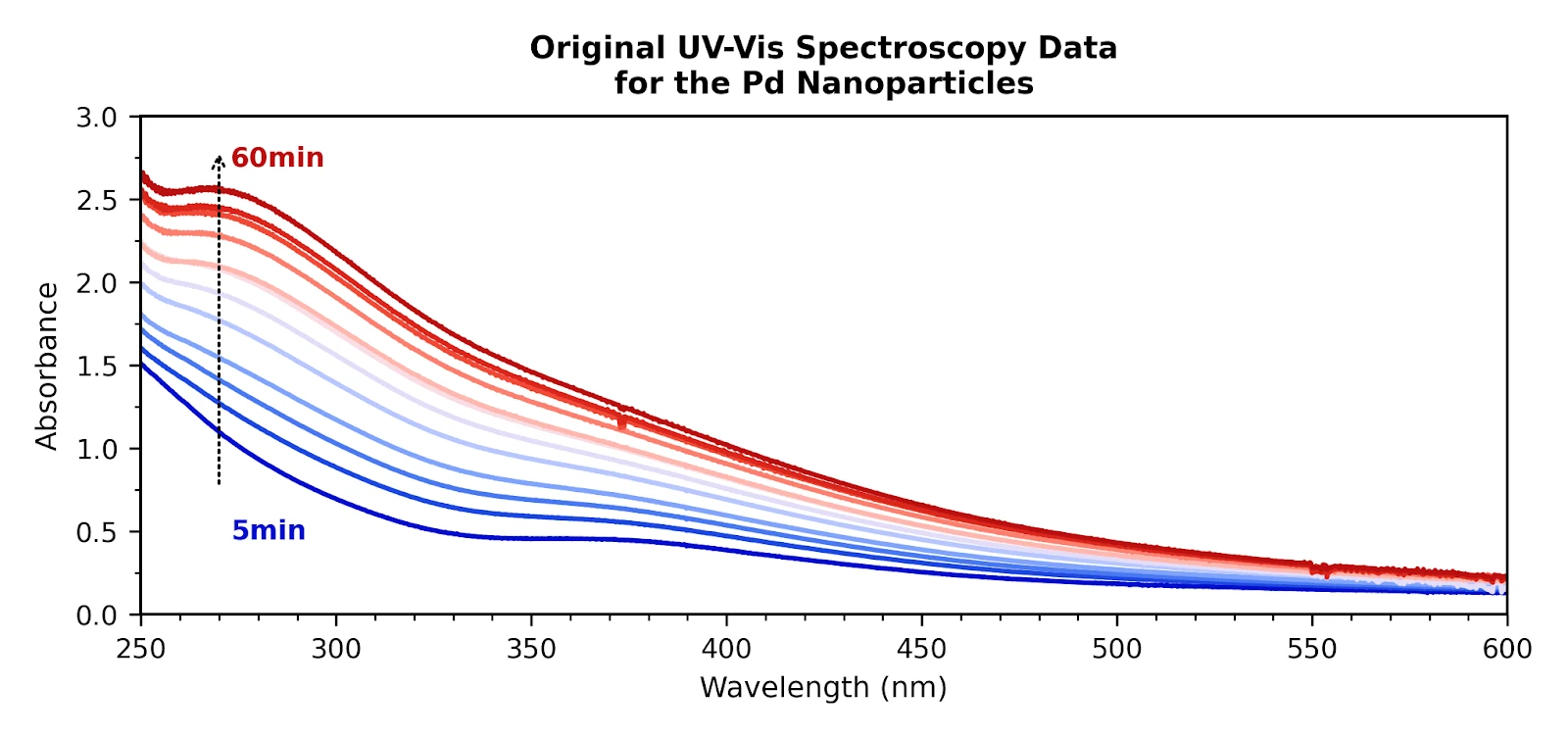
- Analyzed UV–vis spectra of aqueous palladium nitrate precursor solutions across wavelengths and stirring times.
- Used principal component analysis to inspect dominant spectral patterns, loadings, and score trajectories.
- Compared residuals from non-negative spectral reconstructions with different component counts.
- Outlined a future calibration linking microscopy-derived cluster size with optical response.
Inside the project
Results & perspective
The work produced a microscopy-analysis workflow and a poster presenting principal-component results and spectral reconstruction residuals. The captured figures show the spectral-analysis results; linking those patterns to calibrated nanoparticle sizes remains a direction for further work.
What I gained
Working with Professor Zang strengthened my ability to explore unfamiliar research directions and learn new tools independently. I began without experience using Python for computational work, learned to build an environment and test a machine-learning model, and later studied PCA through research papers before translating the mathematics into code. This experience made me more resilient and open to unfamiliar methods, preparing me to take on more complex engineering work.