PDF
Final design report
PDF · 1.7 MB
A sealed environment, built around real research constraints.
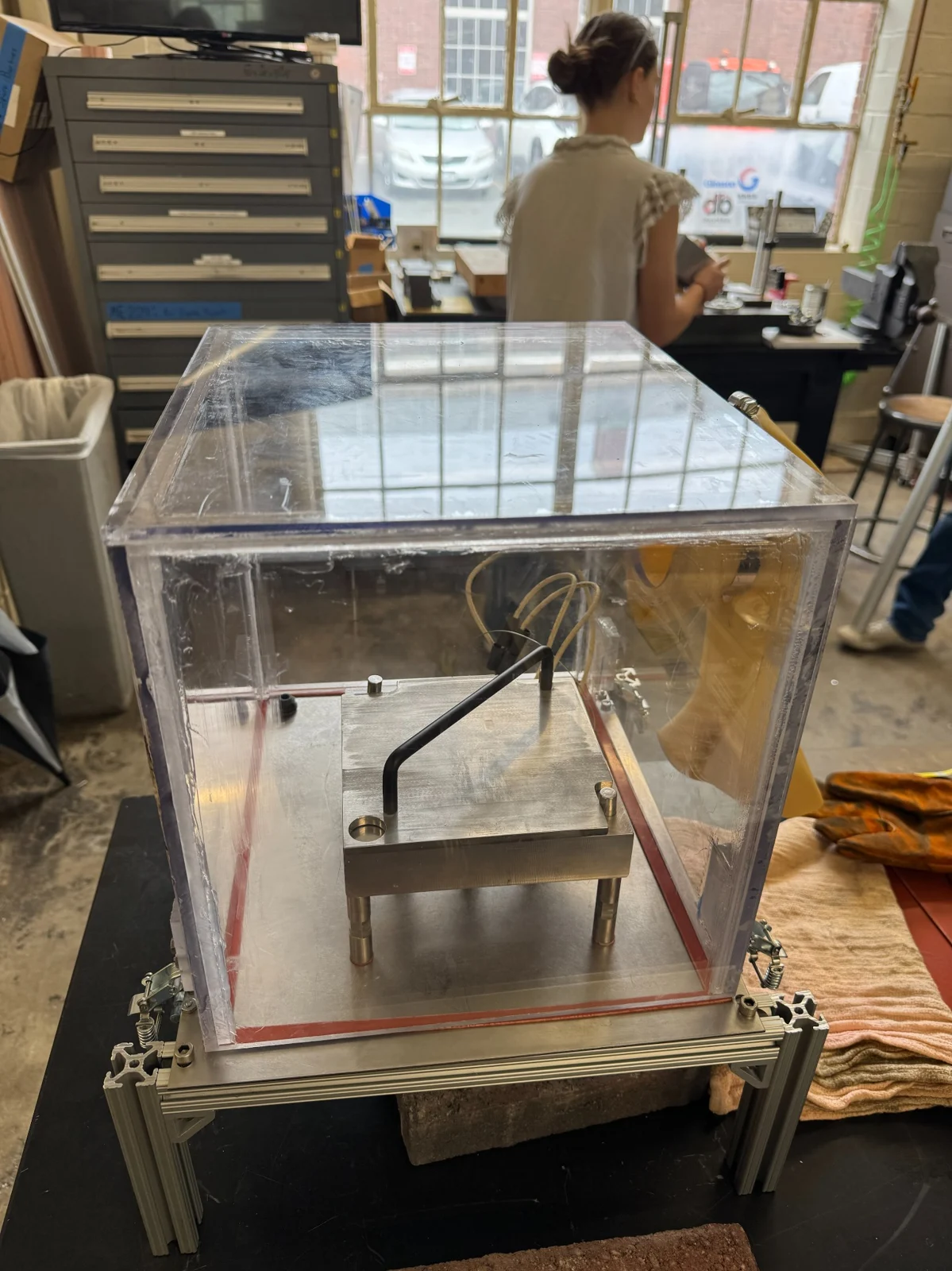
Fabricated glovebox and stainless-steel reactor assembly.
A custom atomic layer deposition (ALD) reactor and glovebox developed for materials research at the University of Rochester’s Laboratory for Laser Energetics. The team worked within an existing hardware layout to create a serviceable enclosure, integrate the reactor, and maintain a controlled environment.
My work focused on glovebox design and fabrication, draw-latch positioning, gasket fabrication, and sealing. Reactor machining and thermal modeling were shared team efforts, with those tasks credited to other team members in the final report.
The measured reactor leak rate was 4.7 × 10⁻¹⁰ torr·L/s, below the 1 × 10⁻⁹ torr·L/s requirement. Low-power heating reached approximately 111–113°C. Full operating-temperature and glovebox dewpoint verification remained future work.
The initial sealing failure taught me that a design that appears effective in theory can encounter unexpected problems during manufacturing and assembly. Refining the gasket material and latch spacing gave me firsthand experience with the engineering workflow from design and analysis to fabrication, testing, and improvement. I also learned from exchanging ideas with teammates and experienced engineers. Solving these challenges together strengthened my interest in engineering design and manufacturing.