PDF
Final project report
PDF · 1.7 MB
Comparing bed covers through CFD and wind-tunnel testing.
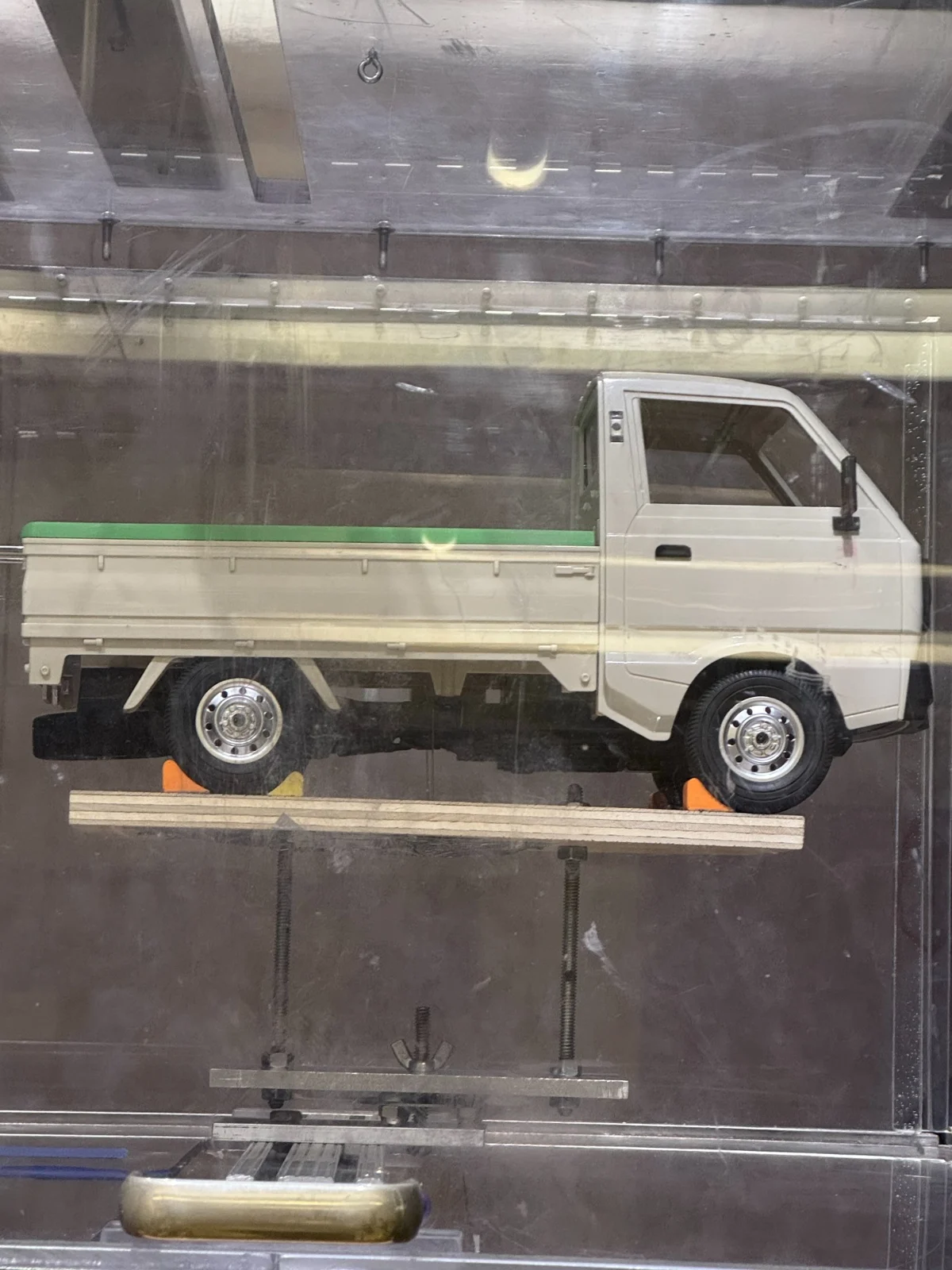
The flat-cover configuration mounted in the wind tunnel.
An experimental comparison of open, flat, and sloped truck-bed configurations on a 1:10 scale Kei truck. The team combined interchangeable prototypes, wind-tunnel measurements, and CFD to investigate how bed geometry affects drag.
I carried out CFD analysis and contributed to the discussion, peer review, and project schedule. The team collectively handled fabrication, testing, and experimental data processing.
Laser-scanning workflow for the truck model. Silent clip.
The flat cover reduced measured model drag by 9.8% relative to the open bed; CFD predicted a 7.5% reduction. The sloped cover produced a smaller measured reduction of 3.51%. These are scale-model results. The CFD solution was not fully converged, and no full-size fuel savings were measured.
Simulation and experiment agreed on the configuration ranking, while idealized geometry, mesh convergence, and scale effects helped explain the remaining differences.